Seattle's Big Rezone Slipped Again. Homeowners Don't Have to Wait.
 Go to Feature
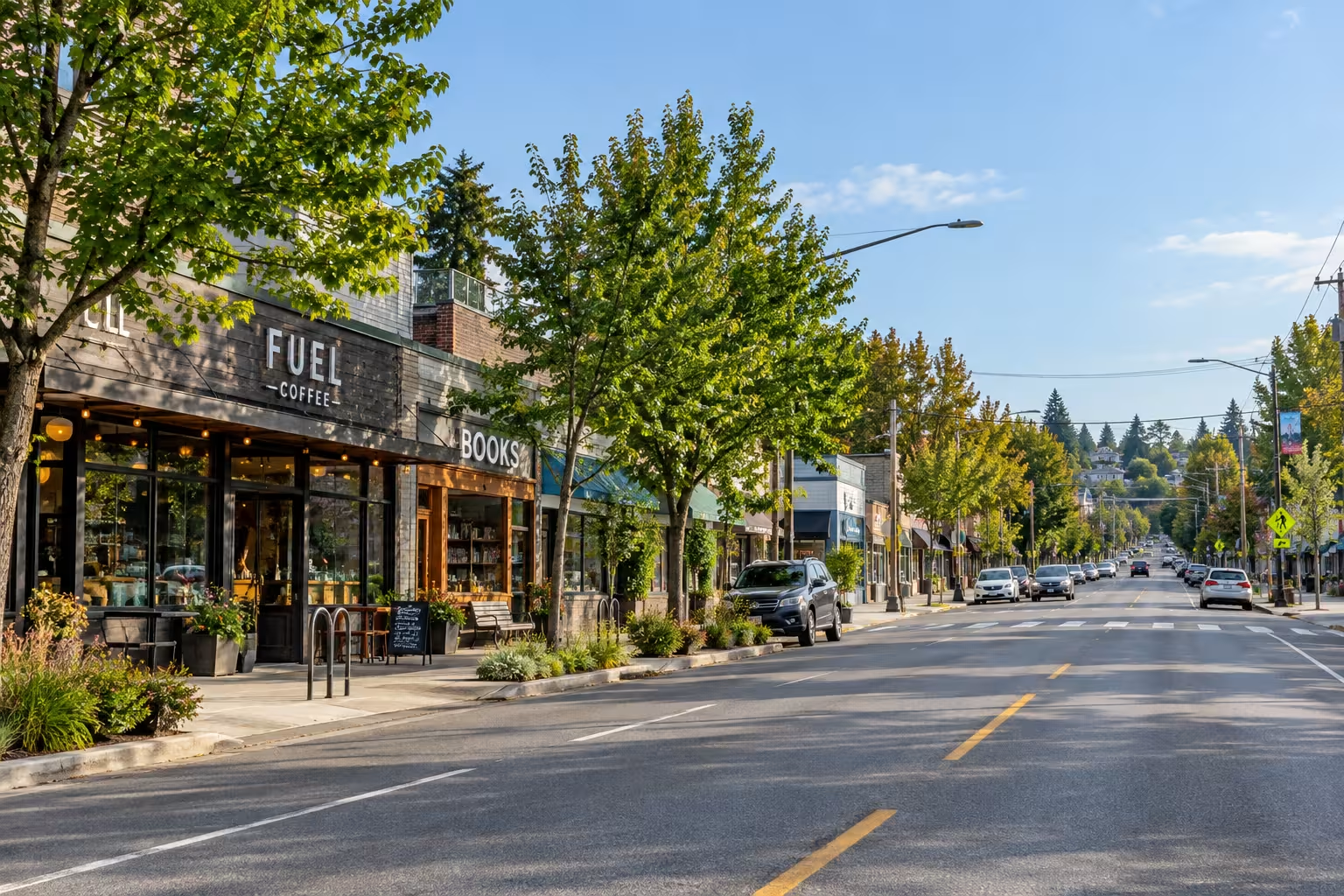
Seattle has a habit of planning for the future while the present slips away. On October 12, The Urbanist reported that the city's next major zoning update, known as Centers and Corridors, has been delayed again. The plan would create 30 new neighborhood centers and allow larger apartment buildings along transit corridors. Now it will not reach a City Council vote until a state board signs off on a bigger environmental review.
We think the delay matters. We also think it should not freeze anyone who owns a lot in this city. Here is our read on what happened, what you can do today, and what we hope Seattle leaders do next.
What happened
Appeals filed against the plan's environmental impact statement argued that the city understated impacts on stormwater and tree canopy. In September, the Growth Management Hearings Board rejected those claims. But it ordered the city to study "maximum possible development" instead of "maximum likely development." That means analyzing many homes that will probably never be built within the 20-year plan.
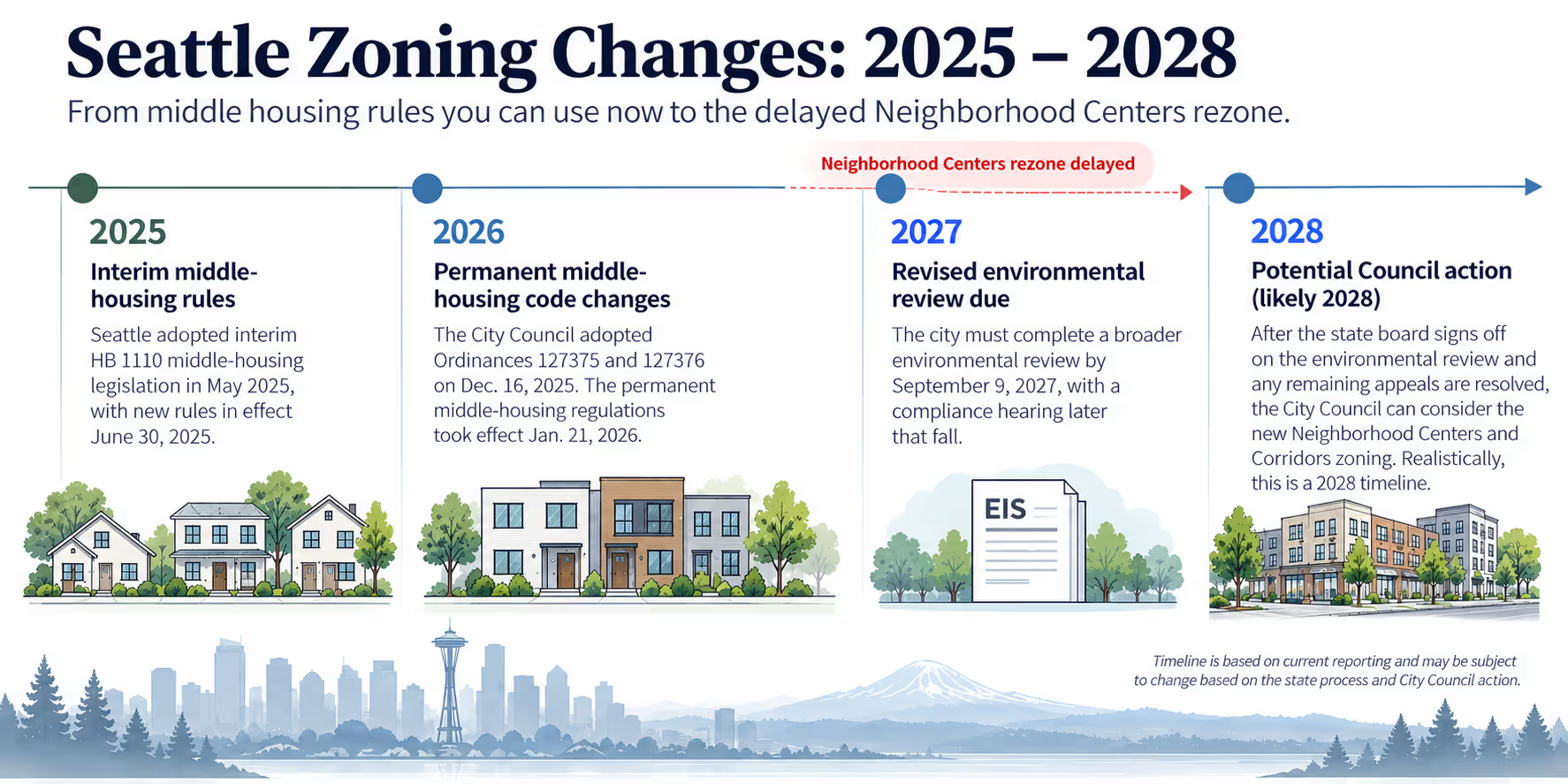
The city now has until September 9, 2027 to finish that work, with a compliance hearing later that fall. [Check] Council cannot approve new zoning until the board signs off. A separate appeal at the city's hearing examiner could stretch into early 2028. Realistically, new neighborhood centers are a 2028 story.
Meanwhile, The Urbanist notes that midrise affordable housing is legal on only about 3% of Seattle's land.
The cost of waiting is real
This is not happening in a healthy market. Seattle permitted fewer than 2,000 housing units in 2025, down 88% from a 2020 peak of 17,400, according to figures cited by The Urbanist. Only 594 multifamily units were permitted in the first four months of 2026.
Permitting is also getting more expensive. The mayor's proposed 2027 budget for the Seattle Department of Construction and Inspections (SDCI) adds a 7% building and land use fee increase on top of a 3.7% inflation adjustment, after an 18% increase in 2026. Final budget adoption is expected November 20.
And 30-year mortgage rates averaged around 7.4% in mid-October. Every month a project waits, the math gets harder.
What you can build today
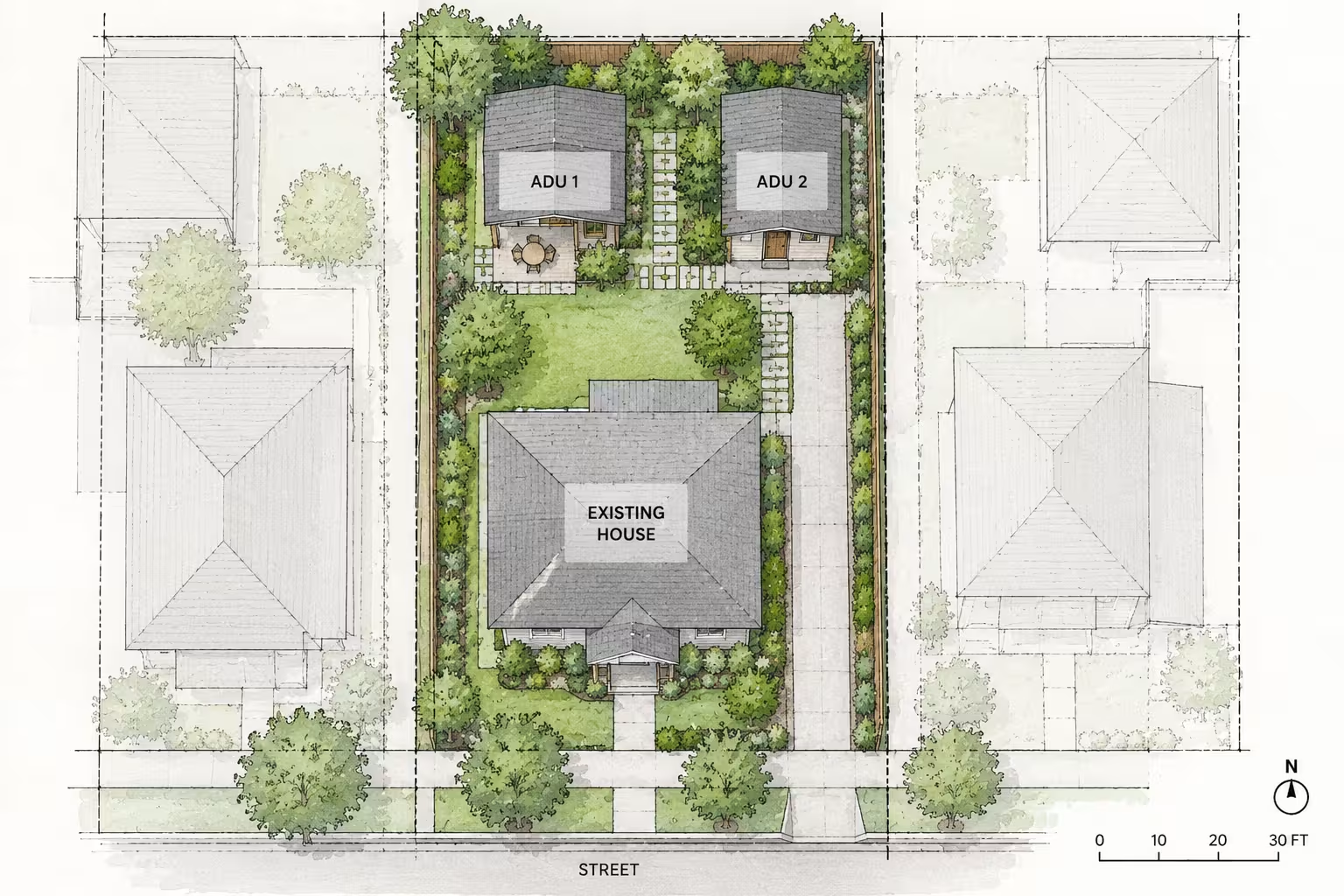
Here is the good news that gets lost in the headlines: the biggest change for most homeowners already happened. Since June 30, 2025, Seattle's Neighborhood Residential zones allow up to four homes on every residential lot, and up to six near a major transit stop or with affordable units. You can also build two accessory dwelling units (ADUs) per lot, each up to 1,000 square feet, as detached cottages, attached units or stacked flats.
That means many families do not need Centers and Corridors at all. If you own a house on a standard lot, you may be able to:
- Add a backyard cottage for a parent or adult child, and a second unit for rental income.
- Replace an aging house with a fourplex or townhomes that keep you on the land.
- Convert a basement into a legal unit while you plan a larger phase later.
The smart move right now is a feasibility study. It tells you what your lot allows today, what it costs, and which option holds up when rates and fees move.
If your lot is in a likely future center
Some owners near neighborhood business districts are waiting for bigger rezoning before they act. That can be reasonable. But waiting has a cost too. Our advice:
- Design a first phase that works under today's rules and leaves room for more later. Think foundations, utility capacity and site layout.
- Keep an eye on the city's mapping so you know if your parcel is in a proposed center.
- Avoid demolishing anything until you know your full path.
What we hope Seattle does next
We are a small, BIPOC-owned studio that works with homeowners, nonprofits and small builders, often in South Seattle. From where we sit, three things would help more than another round of studies.
1. Treat the environmental review as urgent
The planning manager overseeing the update called it "a pretty heavy lift" and said finishing early is unlikely. We understand. But the city should staff it like the housing emergency it is and report progress publicly.
2. Stop raising costs on the smallest projects
Fee increases land hardest on the people with the thinnest margins: homeowners adding one unit and local builders doing four. We would like to see fee relief or a flat fee path for ADUs and small middle housing projects, paired with faster reviews.
3. Pass fee relief that protects vulnerable neighborhoods
Councilmember Dionne Foster has proposed a two-year, 80% cut to Mandatory Housing Affordability (MHA) fees for stalled projects, while keeping the full fee in Beacon Hill, the Central District and the Chinatown-International District. A companion resolution would study an inclusionary requirement in Neighborhood Residential zones. We support getting stalled homes moving, and we support protecting communities facing displacement. This proposal tries to do both. Any future requirement in Neighborhood Residential zones should be designed so it does not stop homeowners from adding a unit or two.
The bottom line
Zoning reform is necessary, but it is not the same as housing. Homes get built when families and small builders can see a clear, affordable path from idea to keys. Seattle already gave homeowners a lot of new tools. Let's use them while the city finishes the next chapter.
Call to action
Not sure what your lot can hold today? Book a feasibility consultation with La Union Studio. We will walk your site, explain your options under current rules, and help you plan a first phase that still makes sense when the next rezone arrives.
FAQ
When will Seattle's Centers and Corridors rezone happen?
The city must finish a revised environmental review by September 9, 2027, followed by a state compliance hearing. Council cannot adopt the new zoning until the board signs off, so 2028 is the most realistic timeline.
Can I build more than one home on my Seattle lot right now?
Yes, in most cases. Since mid-2025, Neighborhood Residential lots can hold up to four homes, or six near major transit or with affordable units, plus up to two ADUs. Site conditions, utilities and trees still affect what fits.
Should I wait for the rezone before building?
Only if your parcel is likely to gain significant new capacity and you can afford to hold. Most homeowners are better served by a feasibility study now and a first phase that works under today's rules.
Sources
The Urbanist: Seattle's Centers and Corridors Zoning Update Delayed Another Year · The Urbanist: MHA Housing Accelerator Proposal Hits Seattle Process Snag · PubliCola: Councilmember Foster Breaks the MHA Logjam · SDCI Building Connections: Mayor Wilson's 2027 to 2028 Proposed Budget for SDCI · SDCI Building Connections: ADUs and Middle Housing · Trading Economics: US Mortgage Rates, October 2026
Media Hub
